ivo@setyadi:~$ ivo.blogspot.com

# catatan teknis, sejak 2001

Algoritma wawancara mendorong pelamar melebih-lebihkan kualifikasi

Pelamar kerja cenderung melebih-lebihkan keahlian mereka saat menyadari AI yang menilai video wawancara, bukan manusia. Ketidakhadiran isyarat sosial membuat kandidat merasa bingung dan secara strategis menggelembungkan skill untuk memenuhi ekspektasi algoritma. Sistem AI yang diuji memberikan skor sama untuk jawaban janggal dan autentik, sehingga tidak layak diandalkan tanpa transparansi metrik. Ketidakmampuan membedakan kejujuran ini mendorong perilaku manipulatif jika kriteria penilaian seperti sentimen atau keyword tidak diungkapkan secara jelas. sumber: futurity.org/ai-job-interviews-3345682 my other side: setyadi.com

what would you do?

2005-12-22 · #Kliping #Renungan

Ethical Dilemma: What Would You Do?

What would you do if you saw a young boy being berated by his baby sitter? The baby sitter doesn't raise a finger, but her words are degrading and harmful to the boy.

You don't know the whole story, and you're not directly involved. What would you do? Intervene? Or mind your own business?

ABC News was curious about this ethical dilemma, and hired two professional actors to play out the scene and examine at what people would do. Would it be possible to predict who will act -- and who won't?

On a sunny day in September, the woman, Wynn Everett, and the boy, Jake Cherry, aged 8, went to a picnic area near a playground and acted out the scenario they had rehearsed.

Situational Factors

When Wynn began to berate Jake, it was clear that intervening wouldn't be an easy decision.
One man within earshot kept reading his newspaper, and others walked right by. ABC News' hidden cameras showed that some women passing by appeared to be disturbed by the abuse, but they kept walking.

One group of women watched for more than eight minutes -- apparently shocked by the abuse and unsure of what to do.

Finally, one of them spoke up. "Do you think that's helping? It's verbal abuse," she said. "You're abusing this kid."

When she was finally notified it was an experiment, Krista Ciarletta, who has two daughters aged 5 and 2, said she had felt she needed to do something.

"It was disturbing to watch that. And I'm sorry I even let it go on as long as I did," she told ABC News' John Quiñones.

Later, Carrie Keating, a professor of psychology at Colgate University, watched a videotape of the experiment.

Situational factors have a major impact on helping behavior, she said. "How empowered we feel makes a difference. How many people are in the area makes a difference. Whether it's a sunny day."

But what about people who didn't act? Virginia Long, a grandmother, said she felt uncomfortable with Wynn's behavior, "but it's hard to step in, too."

Erin Flynn, a mother of twins, said she was afraid. "I didn't know," she said, "if she had somebody else with her, a husband or somebody that was going to come over and potentially hurt me or my children."


A Different Approach

Elise Campbell is another person who stopped Wynn from berating Jake. But unlike Ciarletta, she began: "You're breaking my heart talking to him like that. I know it's not my business."

Campbell, a mother of a young daughter, just over a year old, went on to sympathize with Wynn. She told her, "I completely understand your frustration -- even with somebody this young, I understand how frustrated you are but there are just other ways to talk to him."

Later, when Keating watched a videotape of this incident, she praised Campbell's approach. "She worked very hard to bring the baby sitter into the sisterhood of mothers there -- into the 'we-ness,' " Keating said.

Campbell later admitted she was initially afraid of Wynn's reaction. But she said she ultimately decided to act because she felt confident in doing so. She is a schoolteacher, and, she said, "I know how kids feel, I know how kids work. And I knew it was wrong."

"Competency makes all the difference," Keating said. Some people also get a "helper's high," she said -- people literally get a rush out of helping, and you can see it in their faces.


Haunted

But that's not the only reason. Personal experience can also compel someone to act.
That's the case with Sutton Smith, the mother of a 2-year-old daughter, and a doctoral divinity student.

Like the others, she also hesitated before acting, partially out of fear. "I was shaking physically when I did it, and my voice was quavering. It's not something that's easy for me to do," she said.

But she says she's still haunted by something that happened when she was in college: She saw a man physically abusing a woman, and did nothing.

"I saw it and I walked away. And I didn't want that ever to happen again," she said.


The Male Perspective

Given Campbell, Sutton and Ciarletta -- are women the only ones to speak up when they see this kind of abuse?
Most of the men in ABC News' experiment just kept walking when they passed Wynn verbally abusing Jake. Keating said women generally relate better to the baby sitter's predicament and behavior than men do.

But what if men were a captive audience -- what if they couldn't just walk by? Wynn and Jake took their scenario to a nearby golf course and staged it at the first hole, where a dozen men were waiting to tee off.

The golfers looked, smiled uneasily, whispered, practiced their swings -- but did nothing as the tirade went on and on. Watching them on videotape, Keating noticed none of them looked at the woman or each other.

"It was almost as if they didn't want to know that this was a serious emergency situation," she said. "If everyone else around you is not doing anything, you figure, it's really not that big a problem."

Psychologists call this failure to act in a group "diffusion of responsibility." It means passing the buck.

Asked why he did nothing, one said, "Well, nobody else was saying anything." Another said, "Management was out here already. I just assumed they would get involved."


Have the Courage

ABC News cameras witnessed one man who did step in. Like Campbell's approach, his was also novel.
Instead of attacking Wynn, Ed Bogosian distracted her from her tirade by talking to Jake. He spent five minutes talking Wynn down, and asking Jake innocuous questions like "Do you like the park?"

Eventually, he reached a comfort level where he could tell Wynn, "Those are rough words. You know what I mean? You wouldn't like that if you were 9 or 7."

Bogosian, a grandfather and social worker, later told ABC News: "I knew that something had to be done. And if they didn't have the courage to do it and they didn't have the responsibility in their hearts to do it, then I would do it."

Keating agrees that bystanders should take action in such situations -- even if they don't have the finesse that Bogosian does. Bystanders can always call 911, and if they're confident and comfortable doing it, they could intervene.

If you know how, getting involved can make all the difference. "Don't count on others to intervene," she said. "Take it on yourself. Think about an action plan."

source:
vocuspr.vocus.com/Forward_13876_1013242.htm

New way to secure communication

2005-12-21 · #Kliping #Sains #Security

Texas A&M electrical engineer says simple scheme can stop electronic eavesdroppers
Dr. Laszlo Kish says his simple scheme can stop electronic eavesdroppers.


COLLEGE STATION, Texas -- James Bond may use the fanciest, most expensive and high-tech devices to thwart would-be eavesdroppers, but in a pinch, the super-spy can use one Texas A&M engineer's simple, low-cost scheme to keep data secure from the bad guys.

Dr. Laszlo Kish, an associate professor in the Department of Electrical and Computer Engineering at Texas A&M, proposed that a simple pair of resistors on the ends of a communications wire such as a phone or computer line could keep eavesdroppers from intercepting secret messages. Added electronic disturbances (called "noise") or the natural thermal noise (called Johnson noise) produced by the resistors makes the scheme function and keep the message secret.

Kish's paper, "Totally secure classical communication utilizing Johnson(-like) noise and Kirchoff's Law," in which he proposes his communications scheme, has been accepted for publication in an upcoming issue of the journal Physics Letters A. (A preprint of the paper is available online at arxiv.org/0509136.) The paper was also featured in a recent issue of Science (vol. 309, p. 2148, 2005).

Kish said that quantum encryption -- communicating with single quantum particles, where one particle carries a single bit of information -- is considered absolutely secure because any eavesdropper will be discovered by the extra noise the eavesdropper introduces into the communication channel as soon as the eavesdropper tries to extract "noisy" information, or bits, from the channel. But Kish said quantum encryption is very fragile and is limited by expense, vibrations, thermal gradients, maintenance needs, speed and distance.

Instead, Kish has proposed a classical, not quantum, encryption scheme that relies on classical physical properties -- current and voltage. He said his scheme is absolutely secure, fast, robust, inexpensive and maintenance-free and relies on simultaneous encrypting of information by both the sender and the receiver.

Picture a line of communication -- the line connecting two telephones or computers. The sender and receiver at each end of the communication line each have two resistors of different resistance. Each randomly connects a resistor between their ends of the wire and ground, and then the sender begins transmitting the message. Using the natural thermal noise produced by the resistors provides stealth, making the communication difficult to discover.

While the line of communication is open, both the sender and receiver monitor the electrical current and voltage in the line. If both the sender and receiver use the larger resistances, the fluctuations, or Johnson noise, in the voltage will be large, while the fluctuations will be small if both use the smaller resistances. If one uses the larger and the other uses the smaller resistance, the fluctuations will be somewhere in between.

Of course, an eavesdropper can also measure this noise, but this intermediate level produced by a pair of large and small resistors provides secure communications, Kish said. Because the sender and receiver use different resistances, the eavesdropper cannot determine the actual location of the resistors or whether it's the sender or the receiver using the large resistance.

The only way an eavesdropper can determine which resistance is being used at which end is to inject current into the communication channel and measure the voltage and current changes in different directions. Doing this, though, exposes the eavesdropper, who is discovered with the very first bit of information extracted. And when an eavesdropper is uncovered, the sender or receiver immediately terminates the transmission of the message before the spy can extract any more information.

"The way the eavesdropper gets discovered is that both the sender and the receiver are continuously measuring the current and comparing the data," Kish said. "If the current values are different at the two sides, that means that the eavesdropper has broken the code of a single bit. Thus the communication has to be terminated immediately."

Kish said that the dogma so far has been that only quantum communication can be absolutely secure and that about $1 billion is spent annually on quantum communication research.

"But my paper proves that classical communication measuring voltage and current can also be secure if we are doing that wisely, and it can be done much more cheaply and more easily than quantum communication," Kish said. "And it's superior to quantum communication because the eavesdropper has to break a few thousands of bits to get discovered in quantum communication. In my scheme, the eavesdropper can extract only a single bit before getting discovered."

Kish directs the Fluctuation and Noise Exploitation Laboratory in the electrical and computer engineering department and is also a researcher in the Electrical and Computer Engineering Division of the Texas Engineering Experiment Station, the engineering research agency of the State of Texas and a member of The Texas A&M University System. TEES administers Kish's research.

For more information, contact
Source: Dr. Laszlo Kish
979/847-9071

Laszlo.Kish@ece.tamu.edu
Reporter: Lesley Kriewald
lesleyk@tamu.edu
(979) 845-5524
News Story 1268, December 2, 2005
Direct page link:
tees.tamu.edu

Quanta akan Garap Laptop Rp 1 Juta

2005-12-14 · #Gadget #Kliping

Rabu , 14/12/2005 12:07 WIB
Quanta akan Garap Laptop Rp 1 Juta
Ni Ketut Susrini - detikInet
 
Laptop Rp 1 Juta (onno)
Jakarta, Pemanufaktur laptop asal Taiwan, Quanta, telah sepakat untuk menggarap proyek penyediaan laptop Rp 1 Juta (US$100). Laptop super murah itu ditujukan untuk negara-negara berkembang.

Organisasi OLPC (One Laptop per Child) telah memilih Quanta, pemanufaktur laptop terbesar di dunia, untuk memproduksi laptop US$100. Ide pembuatan laptop tersebut muncul dari Nicholas Negroponte, kepala laboratirium MIT Media Lab.

Nama Quanta mungkin tidak banyak yang tahu. Tapi sebenarnya banyak orang memakai hasil produksinya, karena perusahaan ini memproduksi laptop untuk Hewlett-Packard, Dell dan lain sebagainya. Quanta menjalin kerjasama jangka panjang dengan Compal, perusahaan yang juga berbasis di Taiwan.

Sebagai ODM (original design manufacturer), Quanta akan memproduksi dan berperan penting dalam menghasilkan rancangan akhir untuk laptop murah ini.

"Banyak yang menyangsikan, laptop murah untuk pendidikan di negara berkembang ini dapat terealisasi," kata Negroponte seperti dikutip detikinet, Rabu (14/12/2005) dari CnetNews.com.

Laptop murah ini dilengkapi sistem operasi Linux dan hemat energi. Sumber energi bisa dari engkol tangan yang melengkapi laptop ini. Jadi, putar engkolnya, laptop akan tetap menyala.

Untuk tahap awal, akan ada 5 juta sampai 15 juta unit laptop yang akan dikirim ke Cina, Brasil, India, Argentina, Mesir, Nigeria dan Thailand.

Sejumlah perusahaan juga terlibat dalam proyek ini, antara lain Advanced Micro Devices (AMD), Brightstar, Google, News Corp., Nortel dan Red Hat.

Banyak yang kagum dengan berlangsungnya proyek ini. Namun begitu, ada juga yang memandang skeptis. Orang nomor satu di Intel, Craig Barrett pernah berkomentar bahwa ide laptop murah ini tidak akan berkembang. Konsumen di pasar berkembang menginginkan komputer dengan fungsionalitas penuh, begitu komentarnya.

Sejarah juga membuktikan, membawa komputer ke kawasan miskin sangatlah sulit. Usaha untuk membawa komputer murah ke Brasil selalu gagal. Simuter, komputer murah yang dibuat di India juga datar-datar saja perkembangannya. Dagangan AMD, perangkat internet berharga murah untuk negara berkembang, juga tidak terlalu diminati. Bagaimana dengan laptop Negroponte? Kita lihat saja nanti!

source: detikinet

The story of a Belgian Kamikaze

2005-12-02 · #Dunia #Kliping


Le récit du parcours de la kamikaze belge! (01/12/2005)
Muriel, convertie à l'islam, avait donné du fil à retordre à ses parents

CHARLEROI La kamikaze belge qui s'est fait exploser en Irak, il y a trois semaines, s'appelait Muriel Degauque. C'était une enfant de Charleroi. Elle était née à Charleroi. Elle avait grandi à Charleroi. Elle avait été serveuse dans un café et vendeuse en boulangerie à Charleroi.Elle était allée à l'Athénée royal de Fontaine-l'Évêque.

Muriel vivait depuis trois ans rue de Merode, près de la gare du Midi, à Bruxelles, avec un Belgo-Marocain de 7 ans son cadet, Issam Goris, tué en Irak par les Américains. En rencontrant Issam, Muriel s'était appelée Myriam.

Pour les parents, c'est Issam qui a converti leur fille à l'islam. Et quand ils parlent de conversion, Jean et Liliane sous-entendent: endoctriné. Car, pour eux, la conversion de Muriel tenait plus d'un lavage de cerveau que d'un sentiment religieux profond et sincère.

La police vient de leur confirmer ce dont ils se doutaient, depuis seulement avant-hier soir. «Depuis environ un mois que nous téléphonions à Muriel, nous tombions constamment sur son répondeur. Quand on a appris mardi soir à la télé qu'une Belge s'était fait exploser en Irak, on a pensé que c'était Muriel. Les policiers ont tout fouillé chrez nous, mais il n'y avait rien à prendre, sauf des photos de notre fille. Nous n'avions plus vu Muriel depuis l'été...«

De braves gens, de condition modeste, courageux. Jean, le papa, a travaillé 47 ans à la Providence. Aux ponts roulants, comme affûteur ensuite. Un sale accident du travail (avec fracture du crâne) le met en prépension. Son épouse, Liliane, a été secrétaire médicale.C'est elle, surtout, qui a élevé les enfants. Jean-Paul s'est tué à 24 ans, à moto, renversé par un véhicule qui avait brûlé un stop. Et notre Muriel qui naît le 19 juillet 1967. Autant son frère est dur à la tâche, courageux, raisonné et raisonnable, autant Muriel a le caractère difficile. «Avait-elle 2 ans et demi? Elle apprenait à parler. Pour Jean-Paul, elle disait Pampaul. Si elle cassait un vase au salon et qu'on lui demandait qui avait fait ça, notre Muriel répondait que c'était Pampaul qui pendant ce temps-là faisait ses devoirs à l'étage.»

Une petite fille qui en fait voir de toutes les couleurs aux parents. «On apprenait de ses instituteurs qu'elle avait le chic pour se coller avec les enfants difficiles.» Aux programmes scolaires, Muriel, qui est jolie fille, préfère les garçons. Sa maman: «Je ne sais combien elle en a eu».

Adolescente, il est difficile de la retenir à la maison. Muriel touche à la drogue. Un juge de la jeunesse se penche sur son cas. La future kamikaze fugue: «Une fois, j'ai fait 170 km pour la retrouver dans les Ardennes».

À chaque nouveau mauvais pas, ses parents, sa marraine font tout pour la récupérer.

Serveuse dans une boulangerie, on l'accuse - à tort, pensent les parents - de chiper dans la caisse. Muriel épouse un Turc, divorce. Rencontre un Algérien et le quitte. Tombe, il y a trois ans, sur Issam Goris qui l'emmène au Maroc. «Comme elle était au chômage, elle est revenue spécialement juste avant les 3 ans pour éviter de perdre ses droits. Hissam était au CPAS. Ils nous disaient qu'ils avaient une maison au Maroc et des chevaux et une Mercedes et trois motos. On n'a jamais su si c'était vrai.»

De retour en Belgique, Muriel revoit peu ses parents. C'est que c'est à chaque fois des heurts. Liliane et Jean ne reconnaissent pas leur fille.

«Au début, c'était le tchador. Plus récemment, Muriel acceptait le voile. Quand on se voyait, ils imposaient leurs règles. Nous étions chez nous, mais mon mari devait manger à la cuisine avec Hissam et les femmes rester au salon. Pas question d'allumer la télé ou d'ouvrir une bière. Mon mari, qui en avait marre, avait décidé que si on se revoyait, il nous laisserait seuls et irait au restaurant. Par contre, avec l'islam, Muriel avait cessé de fumer. La dernière fois que nous nous sommes vus, on leur a dit qu'on en avait assez qu'ils essaient de nous endoctriner.»

Les parents de la kamikaze belge veulent savoir - ils l'ignorent à ce moment - si leur fille a fait des victimes en Irak? Des femmes? Des enfants? Des vieillards? Ils veulent savoir ce qu'est devenu Hissam Goris: «Celui-là, si je le tenais, je crois que je le démonterais en morceaux».

Nous demandons aux parents s'ils sont tristes. La maman reste très froide. Le papa essuie une larme, mais c'est surtout parce qu'on évoque le souvenir de Jean-Paul mort, lui, sans l'avoir voulu. «De la peine? C'est notre fille quand même. Avec nos moyens, nous lui avons donné tout ce que nous pouvions, et même plus.»

Une fille gentille? Sa mère: «Un jour, j'ai été hospitalisée 15 jours. Muriel travaillait à 500 m de l'hôpital: elle n'est pas venue une seule fois. À ma sortie, je lui ai demandé si elle se souvenait qu'elle avait une maman. Elle m'a regardée. Je lui ai dit: Mais oui, t'es pas venue me voir une seule fois. Elle m'a répondu qu'elle n'avait pas le temps pour ça...»

source dhnet.be

===============
Translated using GoogleTrans:

The account of the course of the Belgian kamikaze! (01/12/2005)
Muriel, converted with Islam, had given to wire with retordre to his/her parents.

CHARLEROI the Belgian kamikaze who exploded himself in Iraq, three weeks ago, was called Muriel Degauque. It was a child of Charleroi. She Had been born In Charleroi. She had grown in Charleroi. She had been a waitress in a coffee and saleswoman in bakery with Charleroi.Elle had gone to the royal Athenaeum of Fountain-the Bishop.

Muriel had lived for three years street of Merode, close to the station of the South, in Brussels, with a 7 year old Belgo-Morrocan his junior, Issam Goris, killed in Iraq by the Americans. By meeting Issam, Muriel had been called Myriam.

For the parents, it is Issam which converted their daughter with Islam. And when they speak about conversion, Jean and Liliane imply: endoctriné. Because, for them, the conversion of Muriel held more than one washing of brain that of a major and sincere religious feeling.

The police force has just confirmed that to them of which they suspected, for only day before yesterday evening. "For approximately a month that we telephone Muriel, we have fallen constantly on his responder. When one learned Tuesday evening with tele that a Belgian had exploded herself in Iraq, one thought that it was Muriel. The police officers very excavated will chrez us, but there was nothing to take, except photographs of our daughter. We had not seen Muriel any more since the summer... "

Good people, of modest, courageous condition. Jean, the dad, worked 47 years with Providence. With the overhead travelling cranes, as setter then. A dirty industrial accident (with fracture of the skull) the met in prépension. His wife, Liliane, were a secretary médicale.C' is it, especially, which raised the children. Jean-Paul killed himself at 24 years, with motor bike, reversed by a vehicle which had burned a stop. And our Muriel which is born on July 19, 1967. As much his/her brother hard with the task, courageous, is reasoned and reasonable, as much Muriel is difficult. "did it Have 2 years and half? It learned how to speak. For Jean-Paul, she said Pampaul. If it broke a mud with the show and that one asked him who had done that, our Muriel answered that it was Pampaul which during this time made its duties on the floor."

A small girl who shows some of all the colors to the parents. "One learned from his teachers that it had the knack to be stuck with the difficult children." With the school syllabus, Muriel, which is pretty girl, prefers the boys. Its mom: "I do not know how much it had of it".

Teenager, it is difficult to retain it at the house. Muriel touches with drug. A judge of youth considers his case. Future the kamikaze running away: "once, I made 170 km to find it in the Ardennes".

With each new bad step, his/her parents, his godmother do all to recover it.

Waitress in a bakery, one shows it - wrongly, the parents think - to bate in the case. Muriel marries a Turk, divorces. Meet an Algerian and leaves it. Fall, three years ago, on Issam Goris which takes it along to Morocco. "As it was with unemployment, it returned especially right before the 3 years to avoid losing its rights. Hissam was with the CPAS. They said to us that they had a house in Morocco and horses and Mercedes and three motor bikes. It was never known if it were true."

Of return in Belgium, Muriel re-examines his/her parents little. It is that it is each time of the clashes. Liliane and Jean do not recognize their daughter.

"At the beginning, it was the tchador. More recently, Muriel accepted the veil. When one saw oneself, they imposed their rules. We were on our premises, but my husband was to eat with the kitchen with Hissam and the women to remain with the show. Not question of lighting the tele one or of opening a beer. My husband, who had some enough, had decided that if one were re-examined, it would only leave us and go to the restaurant. On the other hand, with Islam, Muriel had ceased smoking. The last time that we saw ourselves, one said to them that one had enough of it that they test to us endoctriner."

Do the parents of the Belgian kamikaze want to know - they are unaware of it at this time - if their daughter made victims in Iraq? Women? Children? Old men? They want to know what became Hissam Goris: "That one, if I held it, I believe that I would dismount it of pieces".

We ask the parents if they are sad. The mom remains very cold. The dad essuie a tear, but it is especially because one evokes the memory of died Jean-Paul, him, without to have wanted it. "Of the sorrow? It is our daughter nevertheless. With our means, we gave him all that we could, and even more."

A nice girl? His/her mother: "One day, I was hospitalized 15 days. Muriel worked to 500 m of the hospital: she did not come only once. At my exit, I asked to him whether it remembered that it had a mom. She looked at me. I said to him: Yes, did not come to you to see me only once. It answered me that it did not have time for that...

Belgian woman bomber identified

2005-12-02 · #Dunia #Kliping

US Marines in Falluja
The bomber allegedly targeted US soldiers in Iraq
Stunned Belgians are starting to get a clearer picture of the Belgian woman identified as a suicide bomber killed in Iraq last month.

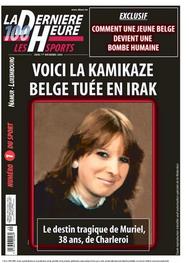
La Derniere Heure newspaper published a photo of the woman it said was the bomber, and interviewed her mother.

The paper says she is Muriel Degauque, 38, from Charleroi, who converted to Islam after marrying a radical Muslim.

Federal prosecutors would not confirm the woman's identity, only that she was a Belgian of European origin.

But La Derniere Heure ran the headline: "This is our Belgian kamikaze killed in Iraq."

Conversion

Degauque's mother Liliane told the paper that she knew her daughter had been involved before police told her she had carried out the attack on 9 November.

"The evening before, I was watching the television which was talking about a Belgian convert who had killed herself in Iraq. I had a bad feeling," Mrs Degauque told La Derniere Heure.

"For three weeks, I had tried to call her but there was no answer."

She said her daughter's interest in Islam started in 2000 and she became a devout Muslim after marrying a Moroccan.

"She became more Muslim than Muslim," said Mrs Degauque. "When she first converted, she wore a simple veil. That was not so far from normal, even if it is strange for a Belgian. But with her last husband she wore a chador [Islamic dress covering women from head to toe]."

Her daughter - believed to be the first female European bomber in Iraq - later travelled through Syria to Iraq, where she died in a failed attack against US troops on 9 November, the paper said.

Surprise mission

A spokesman for the federal prosecutor's office, Eric Van Der Sypt, said the woman's husband had disappeared in Iraq, but could not confirm reports that he had died in a separate incident.

He said five people arrested on Wednesday were suspected of links to the bomber and had been charged with terrorism offences, including participating in terrorist activities and falsifying documents.

He said the fact that a Belgian woman had carried out a suicide mission in Iraq was a surprise, but it would have happened "sooner or later".

"But it could have been a French man or British woman," he said. "They are obviously recruiting. We know we have made arrests and stopped some networks, but who can tell for the future?"

http://news.bbc.co.uk/2/hi/europe/4488642.stm